
Orangeburg Pipe in Greeley: Signs, Lifespan and Repair Options
Orangeburg is a fiber sewer pipe used in many homes built after World War II. It softens and loses its shape with age. Here’s how to tell if your Greeley home has it, what your camera video means and which fix fits the stage your line is in.
Talk to a local sewer pro
Think you have Orangeburg pipe?
Call and tell us when the home was built and what’s happening. A local sewer pro can explain what a camera check will show and the price before work starts.
What is Orangeburg pipe?
Orangeburg is a sewer pipe made of wood fiber pressed with coal tar pitch. Some people call it tar paper pipe or bituminous fiber pipe. It was cheap and light, so builders used it widely from about 1945 to 1973. Over time it soaks up moisture, softens and can flatten or collapse.
It caught on after World War II, when metal was scarce and new homes were going up fast. Plastic pipe took over in the 1970s, and the Orangeburg, New York plant that made it closed at the end of 1972. Many of those lines are still in the ground today.
On this page 11 sections
- How do I know if I have Orangeburg pipe?
- How long does Orangeburg pipe last?
- Signs your Orangeburg sewer pipe is failing
- Reading your camera footage
- Orangeburg pipe repair: can you reline it?
- Can you replace just the bad section?
- Does Orangeburg pipe always need to be replaced?
- Why Greeley ground is hard on Orangeburg
- Buying a home with Orangeburg pipe
- Is Orangeburg pipe dangerous?
- Frequently asked questions
How do I know if I have Orangeburg pipe?
If your home or its sewer line dates from about 1945 to 1973, Orangeburg is possible. The only sure way to know is a camera check. On video, Orangeburg usually looks dark and rough, and older sections may look oval instead of round. It can be mistaken for cast iron.
One line can be a mix. Part of it may have been replaced with plastic while the rest is still Orangeburg, so check the whole run.
How long does Orangeburg pipe last?
Orangeburg was expected to last about 50 years, but many lines start failing around 30 years, and some show problems in 10 to 20. A line put in between 1945 and 1973 is now roughly 50 to 80 years old, so most are living on borrowed time.
U.S. national figures | Years |
|---|---|
Projected life when installed | About 50 |
When many lines start to fail | Around 30 |
Earliest problems reported | 10 to 20 |
Common ranges quoted nationally | 25 to 50, or 30 to 50 |
These are national figures, not Greeley data. How long your line lasts depends on the soil, the bedding under the pipe, roots and how it has been cleaned.
Signs your Orangeburg sewer pipe is failing
The most common signs are backups that keep coming back, slow drains all over the house, a sewer smell and sunken or soggy spots in the yard over the line. They happen as the pipe softens, goes oval and lets roots and soil in.
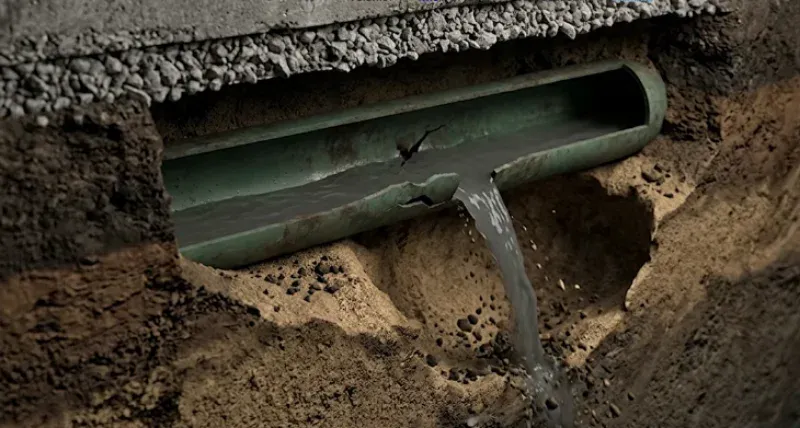
Here’s what’s happening underground: the fiber walls soak up moisture, soften and start to peel apart in layers. Soil pressure then squeezes the pipe out of round. Roots find the soft spots and push right through the wall.
Reading your camera footage
What the camera shows decides the fix. A pipe that’s still round may be lined. Once it goes oval, lining is usually ruled out and bursting is the common fix. A collapse is burst if the bursting head can pass, or dug up if it can’t.
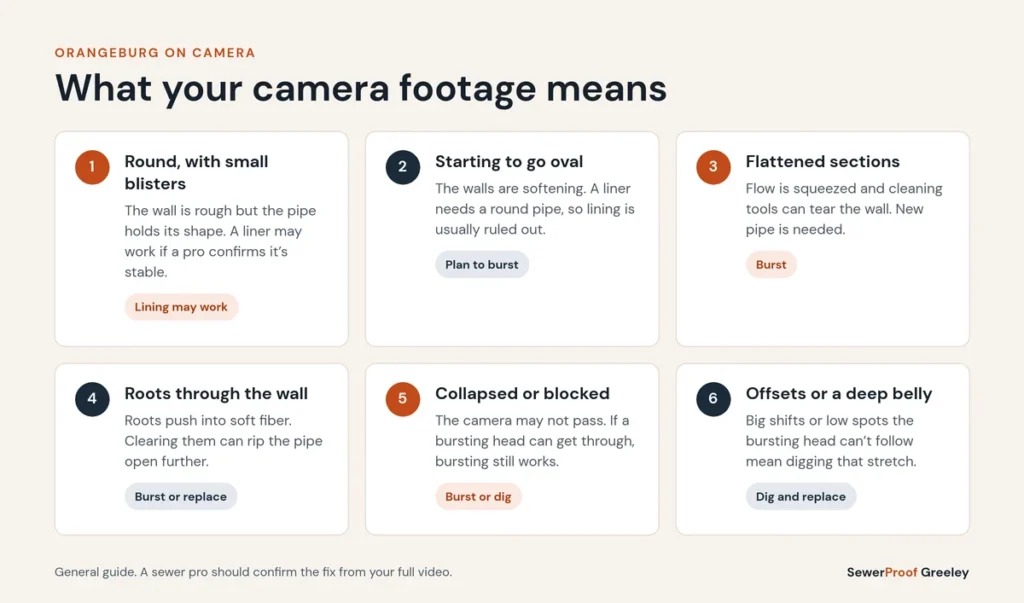
What the video shows | What it usually means | Usual fix |
|---|---|---|
Round pipe, small blisters or cracks | Early wear, pipe still stable | Lining may work, if a pro confirms it |
Pipe starting to go oval | Walls are softening | Plan for bursting |
Flattened sections | Flow is squeezed | Bursting |
Roots through the wall | Soft walls are failing | Bursting or replacement |
Collapse or camera can’t pass | The line is broken | Bursting if the head can pass, otherwise digging |
Big offsets or a deep belly | The path is badly shifted | Dig and replace that stretch |
Ask for the full video with a distance counter, not just a few screenshots. You want to see every section of the line, not only the worst spot.
Have camera video already?
Call and walk us through what it shows. A local sewer pro can tell you which stage your line looks like and what the next step and price would be.
Orangeburg pipe repair: can you reline it?
Only in some cases. A liner needs a round, stable pipe to form around. If your Orangeburg line is still round with only moderate damage, lining may work. If it has gone oval, flattened or collapsed, lining usually isn’t an option, and pipe bursting or digging is the better fix.
Learn more about trenchless sewer repair and replacement in Greeley, or see typical sewer repair prices.
Can you replace just the bad section?
Usually not with Orangeburg. Patching one spot puts more stress on the old pipe on either side, and the next weak spot often fails soon after. Most sewer pros recommend replacing the whole Orangeburg run, from the house to where it meets sound pipe.
Spot repairs make more sense for lines that are sound except for one problem, like a cracked joint in otherwise good clay pipe. See sewer spot repair for when that works. Where new pipe meets old, a transition coupling joins the two.
Does Orangeburg pipe always need to be replaced?
Sooner or later, yes. It doesn’t last forever, and most of it in the ground today is past its expected life. The real question is timing. A line that’s still round with no backups can often wait while you plan. A line that’s oval, rooted or backing up should be replaced soon.
Why Greeley ground is hard on Orangeburg
Orangeburg fails under pressure and moisture, and Greeley soil brings both. Many places on Colorado’s plains have clay soils that swell when wet and shrink when dry. Winters add freeze and thaw. Each cycle squeezes a soft fiber pipe a little more.
We don’t know of any public map showing where Orangeburg is in Greeley. Don’t assume a street or neighborhood has it, or doesn’t. Only a camera check can tell you.
Buying a home with Orangeburg pipe
If a pre-purchase scope finds Orangeburg, treat the line as near the end of its life. You can ask for a replacement credit, ask for a lower price, plan to replace it yourself after closing, or walk away before your inspection deadline.
Get a written replacement quote before your objection deadline so your request has a real number behind it. See our guide to a sewer scope before buying a home in Greeley.
Is Orangeburg pipe dangerous?
Buried and left alone, the pipe itself isn’t a daily hazard. The real risk is sewage backing up into your home when it fails. Some sources note that certain fiber pipes were made with asbestos fibers, so if the old pipe is cut or dug up, let a pro handle it.
Many home policies don’t cover a sewer line that fails from age or wear. See what home insurance covers for sewer lines. And before any digging, Colorado 811 marks public utility lines for free with at least two full business days’ notice.
Frequently asked questions
Talk to a Greeley sewer pro about Orangeburg pipe
Not sure what’s under your yard? Start with a camera check. A local sewer pro can show you the video, explain which stage your line is in and give you the price before any work starts. Call any time about Orangeburg pipe in Greeley. Or start with our guide to sewer line repair in Greeley.