
Frozen Sewer Line in Greeley

Drains backing up in a cold snap? A sewer line can freeze where it runs shallow, where water sits in a low spot, or where a slow trickle builds ice. Here’s how to tell a frozen line from a clog, what to do right now, and how to keep it from happening again.

Talk to a local sewer pro

Drains stopped in the cold?

Call any time and tell us what’s happening. A local sewer pro can tell you what to do first and explain the price before work starts.

  • Answered 24/7, nights and weekends
  • Thawed from the inside, no torch
  • Camera check after it flows
  • Answered 24/7, nights and weekends
  • Camera check before any dig
  • Price explained before work starts
  • Local Greeley-area sewer pros

Can a sewer line freeze in Greeley?

Yes, but it takes the right spot. Most of a sewer line sits deep enough to stay above freezing, and warm wastewater helps. A frozen sewer line in Greeley usually starts where the pipe runs shallow or exposed, where water sits in a low spot, or where a slow, constant trickle freezes in layers.

Where a sewer line freezes in winterCross-section of a Greeley-area home in winter. The Greeley-area building code uses a 30-inch frost depth. A sewer line most often freezes where it runs shallow or exposed, such as where it leaves the house or passes under a cold crawl space, where water sits in a low spot called a belly, and under driveways where packed snow and no snow cover let frost go deeper. A frosted-over roof vent can also make drains gurgle and run slow in a cold snap.Frost depth about 30 inchesDrivewayStreetCity mainFrosted roof ventShallow where it exitsWater sitting in a bellyPacked snow, no coverLow spots and shallow runsWater that sits or a line nearthe surface freezes first.A slow trickleConstant drips can freeze inlayers inside the pipe.No torch, no chemicalsStop using water and call.Warm water from inside thaws it.

The Greeley-area building code uses a frost depth of 30 inches, and January nights here average around 15°F. Sections of pipe near the house, in a cold crawl space or under a plowed driveway sit closest to that cold. That’s where ice forms first.

On this page 7 sections
  1. Frozen sewer line or a regular clog?
  2. What to do if your sewer line freezes
  3. How a sewer pro thaws a frozen line
  4. Why some sewer lines freeze and others don’t
  5. How to keep your sewer line from freezing
  6. Who handles a frozen sewer line in Greeley?
  7. Frequently asked questions

Frozen sewer line or a regular clog?

Both stop the drains, so look at the timing. A line that quits during a cold snap, after a few days of light use or when the house was empty, points to ice. A line that backs up in any weather, again and again, points to a clog, roots or a sag. A camera check settles it.
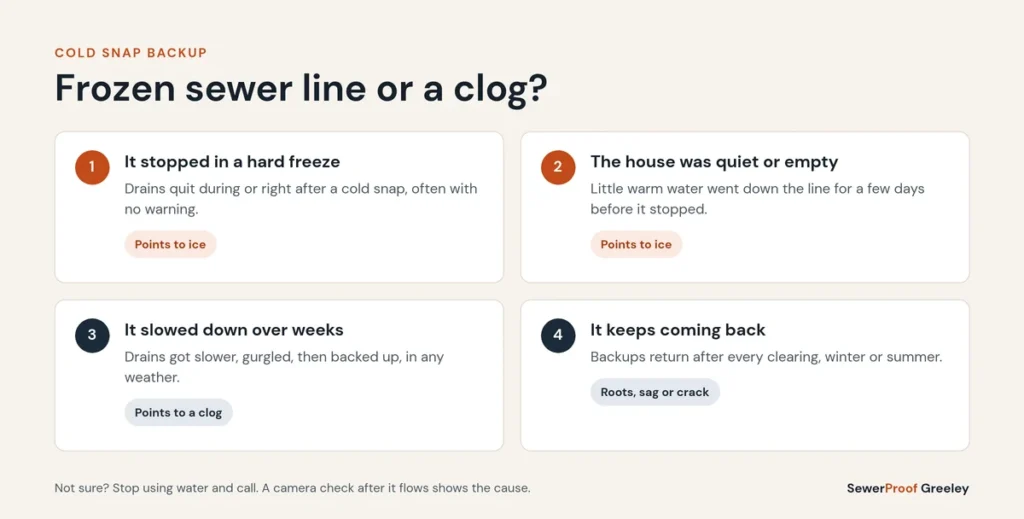
Chart of clues that point to a frozen sewer line in Greeley versus a clog, roots or a sag
Clues that point to a frozen sewer line, and clues that point to a clog or a damaged pipe.

Clue

Points to ice

Points to a clog

When it started

During or right after a hard freeze

Any time of year

Before it stopped

House was empty, or very little water was used

Slow drains for weeks, or roots in past years

What drains do

Everything stops at once, often with no warning

Gets slower over time, gurgles, then backs up

After a warm afternoon

Sometimes starts draining again on its own

Stays blocked until it is cleared

Outside cleanout

Cap or pipe may be frosted or iced

Usually normal

If it looks like a clog instead, see clogged main sewer line. Gurgling in cold weather can also come from a frosted roof vent; see gurgling drains.

What to do if your sewer line freezes

Stop using water first, because everything you pour in will back up into the lowest drain. Don’t use a torch, chemicals or salt. Turn up the heat inside, keep a basement or crawl space warm, and call a sewer pro who can thaw the line from the inside and check it with a camera.

  • 1 Stop running water, flushing and laundry so nothing backs up.
  • 2 Raise the heat and open cabinet or crawl space doors where drain pipes run along outside walls.
  • 3 Look at the outside cleanout. If the cap is iced or water is standing in it, note that for the sewer pro.
  • 4 Don’t pour boiling water down drains. Very hot water can damage plastic pipe and won’t reach ice deep in the line.
  • 5 Call for help, and say it stopped in the cold. That helps the crew bring the right equipment.
  • No open flame The City of Greeley warns against open flame for frozen pipes. A torch near pipes is a fire risk and can crack them.
  • No chemicals or salt Drain cleaners and salt won’t melt ice deep in the line. They can harm pipes and splash back on whoever clears it.
  • No running water Leaving water running to melt it just adds to the backup. The ice is usually far from the faucet.

Sewer line frozen right now?

Stop using water and call. A local sewer pro can tell you what to do next and explain the cost before anyone comes out.

How a sewer pro thaws a frozen line

The safest way is from the inside. A pro opens the cleanout, runs a hose or thawing line up to the ice and melts it with warm water, often with a jetter. Once it flows, a camera shows why it froze, such as a belly holding water or a shallow run, so it doesn’t happen again.

  • Warm water is fed through the cleanout right to the ice, not poured in from a sink.
  • Jetting can clear what’s left and flush the line.
  • A camera check finds the low spot or shallow section that let ice form.
  • If ice cracked an older pipe or pulled a joint, the camera shows that too.

More on the tools: hydro jetting and sewer camera inspection. No cleanout outside? Ask about adding a cleanout, since it makes winter thawing much easier.

Why some sewer lines freeze and others don’t

Ice needs cold, still water. Lines that freeze usually have a spot where water sits or barely moves, or a spot where frost can reach the pipe. Fix that spot and most lines never freeze again, even in a hard Colorado winter.

  • Water sitting in a belly A low spot holds water that can freeze solid between uses. See our page on a sewer line belly.
  • Shallow or exposed pipe Where the line leaves the house, runs through a cold crawl space or sits close to the surface.
  • A slow, steady trickle A running toilet or dripping fixture can freeze in thin layers inside the pipe until it closes.
  • Packed snow, bare ground Plowed driveways and packed snow let frost go deeper than ground under loose snow.
  • Empty or quiet homes A house left empty, or one person using little water, sends less warm water down the line.
  • Frosted roof vent In a deep freeze, frost can narrow the vent on the roof. Drains gurgle and slow down even when the line is open.

Causes like these are also listed in university extension guidance for cold-climate homes. If your line has a known low spot, read about fixing a sewer line belly.

How to keep your sewer line from freezing

Keep warm water moving through the line, keep the house heated even when you’re away, and fix any dripping fixture or running toilet before winter. If a camera has shown a belly or a shallow section, getting that spot fixed is the long-term answer.

  • Keep the heat on when you travel, and ask someone to run water in the house every few days.
  • Use water normally. The City of Greeley suggests running laundry or the dishwasher during the coldest part of the night.
  • Fix a running toilet or dripping faucet so a thin trickle can’t build ice in the line.
  • Insulate drain pipes in a garage or crawl space, and keep crawl space vents closed in winter.
  • Keep the outside cleanout capped, and don’t pile plowed snow on top of the line’s path.
  • Had a frozen line before? Have it checked with a camera in the fall.

The City also suggests a thin stream from the kitchen faucet on nights below 20°F to protect water pipes. If your sewer line has a known low spot, ask a sewer pro whether that steady trickle could freeze in the line instead.

Who handles a frozen sewer line in Greeley?

In Greeley, the service line from your house to the City main is yours to maintain, so a frozen line on your side is a call to a private sewer pro. If neighbors are backing up too, the City main may be involved, so tell the City first.

See who owns the sewer line in Greeley for the full split. For damage from a backup, check what insurance may cover. If sewage is already coming up, see emergency sewer repair.

Frequently asked questions

Yes, where it runs shallow, where water sits in a low spot, or where a slow trickle builds ice. Most of the line stays above freezing.

All the drains stop during or right after a hard freeze, often after light use or an empty house. A clog builds up slowly in any weather.

It’s not a good idea. Boiling water can damage plastic pipe and won’t reach ice deep in the line. A pro thaws it from the cleanout.

Sometimes, after a warm spell. Meanwhile any water you use backs up, so stop using water and call a sewer pro.

It can, especially older pipe or a weak joint. After it thaws, a camera check shows any damage.

Keep the heat on, keep water moving, fix drips and running toilets, and fix any belly or shallow section a camera finds.

Call about a frozen sewer line in Greeley

Drains stopped in a cold snap? Call any time. A local sewer pro can thaw the line from the inside, find out why it froze and explain the price before work starts. See all our Greeley sewer line repair services.