
Clay Sewer Pipe in Greeley: Why the Joints Fail and How to Fix Them
Clay sewer pipe is tough stuff. The fired clay itself can last a century. The trouble is where the short sections meet. Here’s how clay lines fail at the joints, what your camera video means and when to keep clearing, line the pipe or replace it.
Talk to a local sewer pro
Roots keep coming back?
Call and tell us how often the line gets cleared. A local sewer pro can explain what a camera check will show and the price before work starts.
Why clay sewer pipe fails at the joints
The clay isn’t the weak point. The joints are. A clay line is made of short sections pushed together end to end. Over time the seals at those joints crack or shift, roots and soil find the gaps, and the line starts to clog, leak or sag, even when the pipe walls are still solid.
Clay pipe, also called vitrified clay pipe (VCP), terra cotta or clay tile pipe, is made from clay and shale fired at about 2,000°F until it turns hard and glassy. Sewer acid that eats cast iron barely touches it. But it’s brittle. It handles weight well and can’t bend at all, so when the ground moves, the joints take the stress.
Clay was used for house sewer lines from the late 1800s into the 1970s, so a home built before the 1970s may well have it. Only a camera check can tell you for sure.
On this page 10 sections
- How long does clay sewer pipe last?
- The joint map: how each joint fails
- How do tree roots get into clay sewer pipe?
- What your symptoms point to
- Clay tile sewer line repair: can it be relined?
- Stop paying for the same clearing?
- Greeley root risk: trees, soil and weather
- Always get a copy of your camera footage
- Clay vs cast iron vs Orangeburg
- Frequently asked questions
How long does clay sewer pipe last?
The clay itself can last 100 years or more, and some clay lines in the U.S. still work after a century. The joints usually give out long before that. Figures quoted in San Diego and Texas put a clay line’s working life at about 50 to 60 years.
Part of the line | Typical life (U.S. figures) |
|---|---|
Fired clay pipe body | Can last 100 years or more |
Mortar or gasket joints | Often fail much sooner |
Working life quoted in San Diego and Texas | About 50 to 60 years |
These aren’t Greeley figures. Roots, soil movement and how the line was laid matter more than the calendar.
The joint map: how each joint fails
Older clay lines often used rigid mortar joints that crack as the ground moves. Later clay lines used flexible gasket joints that hold up better but still age. Joints can also shift out of line or crack at the bell. Each problem points to a different fix.
Joint problem | What happens | Usual fix |
|---|---|---|
Cracked mortar joint | Gaps open and roots grow in | Lining, if the pipe is still in line |
Aged gasket joint | The seal shrinks or shifts and leaks | Lining |
Offset joint | One section drops, leaving a ledge that catches waste | Spot repair if it’s one joint |
Separated joint | Soil washes in and sewage leaks out | Spot repair or lining, based on the gap |
Cracked bell | Groundwater gets in, sewage gets out, soil washes away | Spot repair before it collapses |
Several offsets or sags | The line is out of line in many places | Replace the line |
Ask the pro to stop at every joint on the video. Each one tells you something.
How do tree roots get into clay sewer pipe?
Roots find water and food leaking from a joint, slip in through the tiny gap and grow. As they thicken, they pry the joint wider, catch paper and grease and slowly block the line. Clay lines have a joint every few feet, so they give roots a lot of doors.
A clog that comes back on a schedule, like every 6 to 12 months, is the strongest sign of roots at the joints. Write down every date the line gets cleared. That pattern tells a pro a lot. See more on tree roots in a sewer line.
What your symptoms point to
Roots aren’t the only cause of a slow clay line. Grease, something flushed, a sag, a blocked vent or a problem in the City main can look similar at first. The pattern of the problem is the best clue before the camera goes in.
What you notice | Most likely cause |
|---|---|
Clogs come back on a regular schedule | Roots at the joints |
Kitchen sink slow first, worse after cooking | Grease buildup |
Sudden clog after something was flushed | Foreign object |
Water sits in the line, slow everywhere | A belly or sag |
Gurgling and smells, but water drains | Blocked vent |
Neighbors back up too | The City main |
If neighbors are backing up too, it may be the City main, not your line. See who owns the sewer line in Greeley.
Tired of the same clog?
Call and tell us how often the line gets cleared. A local sewer pro can explain whether lining would end the cycle and what it costs before any work starts.
Clay tile sewer line repair: can it be relined?
Yes, often. If the clay line still runs straight with roots, cracks or open joints, a liner can seal every joint at once and leave a smooth new pipe inside. It won’t fix big offsets, sags or a collapse. Those need a spot repair or replacement.
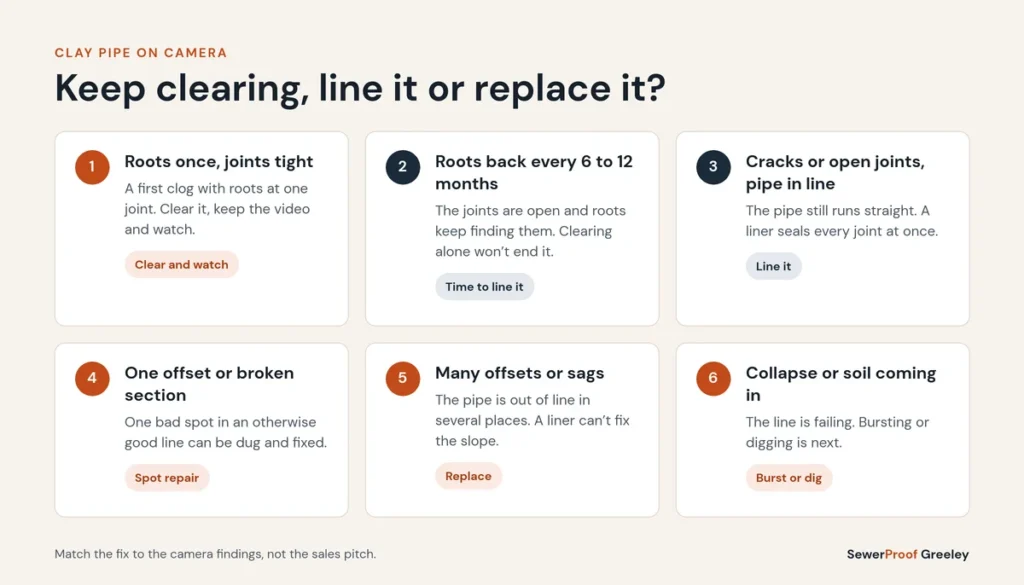
For how lining works and when it doesn’t, see trenchless sewer repair and replacement in Greeley.
Stop paying for the same clearing?
Clearing is cheap per visit, but it adds up and never ends. Lining costs more once and stops roots from getting back in. Whether lining pays off depends on how often your line clogs and how long you plan to stay.
Option | Rough cost |
|---|---|
Clearing in Greeley, per visit | About $125 to $315 |
Clearing twice a year for 5 years | About $1,250 to $3,150 |
Hydro jetting in Greeley, per visit | About $300 to $600 |
Lining, U.S. national figure | About $80 to $250 per foot |
Clearing alone often costs less over a few years. Lining starts to make sense when roots come back fast, the joints are opening up or you plan to stay long. It also stops the slow damage roots do to the joints, which can lead to a much bigger repair later.
Greeley root risk: trees, soil and weather
Big shade trees, shifting clay soil and freeze and thaw all stress clay joints. Trees with thirsty, spreading roots, like cottonwoods, willows and silver maples, are common culprits. Roots can spread well past the branches, often two to three times as wide.
A common rule of thumb is to keep new trees at least 10 feet from the sewer line, and farther for big species. There’s no public data on which Greeley streets have clay lines, so don’t assume yours does or doesn’t. The City is replacing aging pipe too: its downtown project replaces about 2.25 miles of water, sewer and non-potable mains, and the City says much of that infrastructure is over 100 years old.
Always get a copy of your camera footage
The camera is the only way to see what’s really going on in a clay line. Ask for the full video, not just a few screenshots. A good inspection records where each problem is, how bad it is and where your line meets the City main.
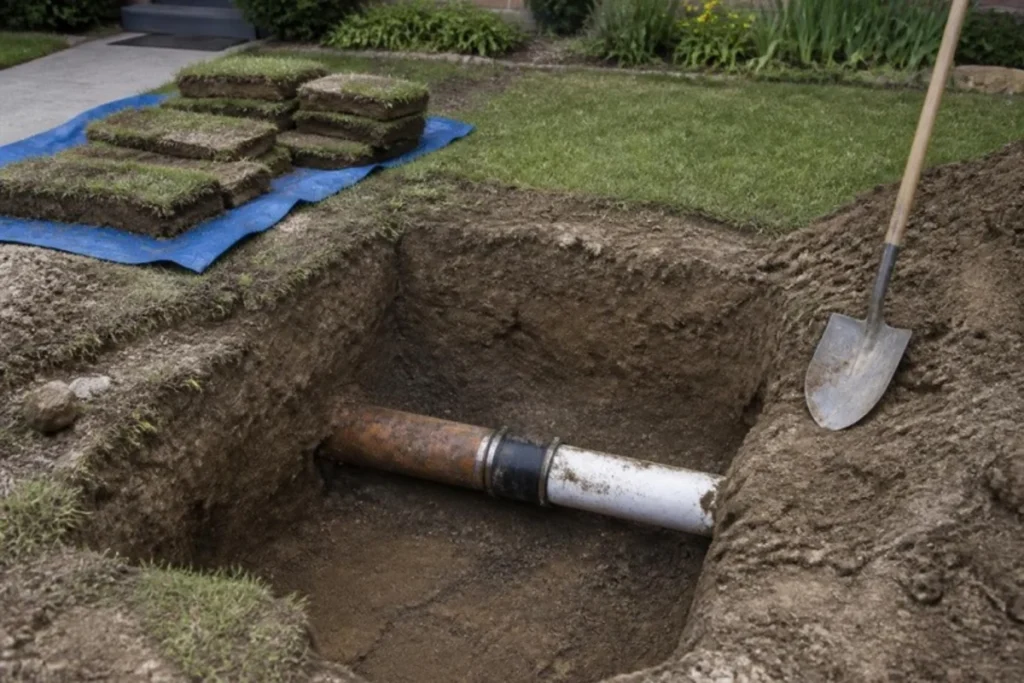
Book a sewer camera inspection, or if you’re buying, see our guide to a sewer scope before buying a home in Greeley.
Clay vs cast iron vs Orangeburg
Each old pipe fails in its own way, so the fix is different too:
Pipe | Weak point | Common fix |
|---|---|---|
Clay | Joints: roots, offsets, gaps | Clearing, lining or spot repair |
Rust scale and channel rot inside | Descaling, lining or replacement | |
Soft fiber walls that go oval | Usually bursting or replacement |
Frequently asked questions
Talk to a Greeley sewer pro about your clay line
Tired of the same clog? Start with a camera check. A local sewer pro can show you every joint, explain whether clearing, lining or replacement fits and give you the price before work starts. Call any time about a clay sewer pipe in Greeley. See our main page on sewer line repair in Greeley.