
Cast Iron Sewer Pipe in Greeley: Descale, Line or Replace?
Cast iron was the standard sewer pipe for decades, and a lot of it is still in the ground. Over time it rusts from the inside, narrows and wears through along the bottom. Here’s how to tell how far gone your line is, and which fix makes sense: descaling, lining or replacement.
Talk to a local sewer pro
Slow drains and an older home?
Call and tell us what’s happening. A local sewer pro can explain what a camera check will show and the price before work starts.
Why old cast iron sewer pipe fails
Cast iron wears out from the inside. Sewer gas turns acidic and eats the iron, rust scale builds up and narrows the pipe, and the water running along the bottom slowly cuts a groove until it leaks. Roots then find the cracks. The outside can look fine while the inside fails.
Sewer gas contains hydrogen sulfide. Inside the pipe it forms an acid that attacks the iron, leaving pits and lumps of rust called tuberculation. Those lumps snag paper and grease, so clogs keep coming back. Pros sometimes call the iron’s slow breakdown graphitization.
On this page 12 sections
- How long does cast iron sewer pipe last?
- Signs your cast iron sewer line is in trouble
- How to tell if you have cast iron
- What channeling looks like on camera
- Descale, line or replace? Pick the right fix
- What is pipe descaling, and does it damage cast iron?
- Is lining as good as replacing?
- What it costs: U.S. national figures
- Lines under a slab or basement floor
- What’s hard on cast iron in Greeley
- Keep an old cast iron line working longer
- Frequently asked questions
How long does cast iron sewer pipe last?
Most U.S. sources put cast iron sewer pipe at about 50 to 75 years, and some say up to 100 in ideal conditions. Cast iron was a standard choice through the 1960s and early 1970s, so many of those lines are now 50 years old or more.
U.S. national figures | Years |
|---|---|
Most common range quoted | 50 to 75 |
Range quoted in the Seattle area | 50 to 100 |
Range quoted in Texas | 50 to 60 |
These are not Greeley figures. How long your line lasts depends on what goes down the drain, the soil and how it has been cleaned. Don’t mix these numbers up with galvanized steel pipe, which wears out sooner.
Signs your cast iron sewer line is in trouble
Watch for slow drains, most often in the basement floor drain or laundry sink, backups after the washer runs or several toilets flush, a sewer smell and a wet or extra-green patch in the yard. Clogs that come back soon after cleaning are a classic cast iron sign.
How to tell if you have cast iron
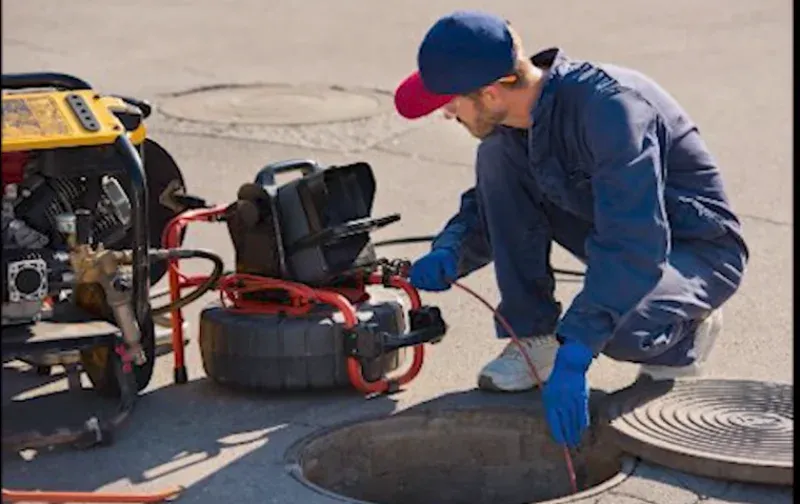
Cast iron sewer pipe is heavy, dark gray or black and usually about 4 inches across, with bell-shaped hubs at the joints. You may see it where the main drain leaves the basement. On camera, old cast iron looks rough and lumpy inside, and the opening looks smaller than it should.
Part of the line may be cast iron and part plastic or clay, so look at the whole run. A sewer camera inspection shows the pipe type, the scale and the distance to any trouble spot. Some fiber pipe can look like cast iron on camera too, see Orangeburg pipe.
What channeling looks like on camera
Channeling, or channel rot, is a groove worn along the bottom of the pipe by years of flowing water and acid. On camera you may see a dark trough or a gap along the bottom while the top of the pipe still looks solid. Once it breaks through, sewage leaks into the soil below.
Descale, line or replace? Pick the right fix
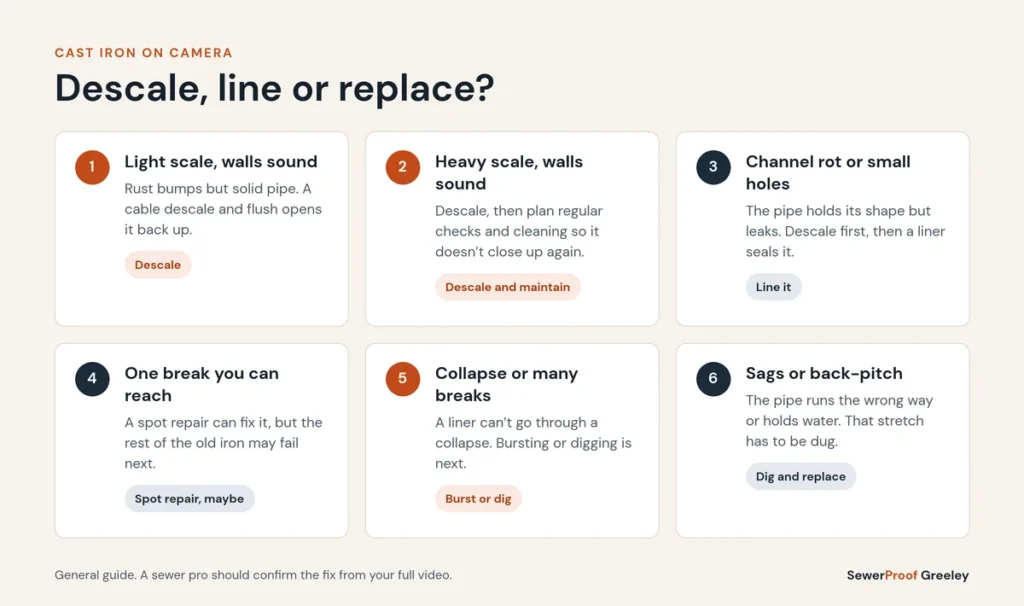
Let the camera decide. If the walls are sound, descaling may be enough. If the pipe holds its shape but has holes or channeling, descale and then line it. If it has collapsed, has many breaks or runs the wrong way, replacement by bursting or digging is the real fix.
What the camera shows | Usual fix | Why |
|---|---|---|
Light scale, sound walls | Descale and flush | Opens the pipe back up |
Heavy scale, sound walls | Descale, then regular checks | Scale builds back over time |
Channeling or small holes, pipe still in shape | Descale, then line it | A liner seals the leaks inside the old pipe |
One break you can reach | Spot repair | Fixes that spot, but other old iron may fail next |
Collapse or many breaks | Pipe bursting or digging | A liner can’t pass a collapse |
Sags, offsets or back-pitch | Dig and replace that stretch | The pipe has to be re-laid at the right slope |
Have camera video already?
Call and walk us through what it shows. A local sewer pro can tell you which fix fits and what it will cost before any work starts.
What is pipe descaling, and does it damage cast iron?
Descaling scrapes rust scale off the inside of the pipe with a fast-spinning cable and chain head, then flushes the debris out with water. Done with the right head and a camera, it’s the standard way to clean cast iron. Too aggressive a tool on thin, rotted pipe can break through, so the camera matters.
Descaling cleans the pipe. It doesn’t rebuild metal that’s already gone. Be wary of any claim that descaling alone adds decades of life.
Is lining as good as replacing?
For a cast iron line that still holds its shape, a liner can work well. It seals cracks and channeling and leaves a smooth new surface inside, often without digging. It won’t fix a collapse, a sag or pipe that runs the wrong way. Replacement gives you all-new pipe, usually PVC or ABS.
Lining
Replacement
Some pros prefer ABS where the ground moves a lot or gets very cold. Learn more about trenchless sewer repair and replacement in Greeley.
What it costs: U.S. national figures
Cleaning and descaling cost the least. Lining and spot repairs cost more, and full replacement costs the most. National figures vary widely by depth, length and access, and we don’t have published Greeley figures for cast iron work, so treat these as a rough guide only.
Work | U.S. national figures |
|---|---|
Cleaning or descaling | About $200 to $300 |
Lining | About $80 to $250 per foot |
Spot repair inside a wall or floor | About $3,000 to $8,000 |
Open-trench digging | About $50 to $450 per foot |
Full replacement | About $100 to $300 per foot |
Depth and access drive the price most. A line 3 feet down in an open yard costs far less to reach than one 8 feet down or under a driveway, patio or basement slab. For Greeley camera and clearing prices, see our sewer repair cost page.
Lines under a slab or basement floor
In many older homes, part of the cast iron drain runs under the basement floor or a slab. Fixing that part means cutting and patching concrete, or lining from inside, and costs rise fast. That’s one more reason to scope an older home before you buy it.
Buying a home with cast iron? See our guide to a sewer scope before buying a home in Greeley.
What’s hard on cast iron in Greeley
Grease is the biggest everyday enemy of old cast iron. It sticks to rough scale and narrows the pipe fast. Add mineral buildup from hard water, freeze and thaw, and clay soils that swell and shrink, and an old iron line gets squeezed from inside and out.
Keep an old cast iron line working longer
If your line is still sound, a few habits buy time:
Many home policies don’t cover a line that fails from age or wear. See what home insurance covers for sewer lines.
Frequently asked questions
Talk to a Greeley sewer pro about cast iron
Not sure how much life your line has left? Start with a camera check. A local sewer pro can show you the video, explain whether descaling, lining or replacement fits and give you the price before work starts. Call any time about a cast iron sewer pipe in Greeley. See all our Greeley sewer line repair services.